Mari Terashima: Fortress of Dreams
Mari Terashima, Fortress of Dreams・夢のとりで, 1991, 19 min, Hi8 video, color & b/w
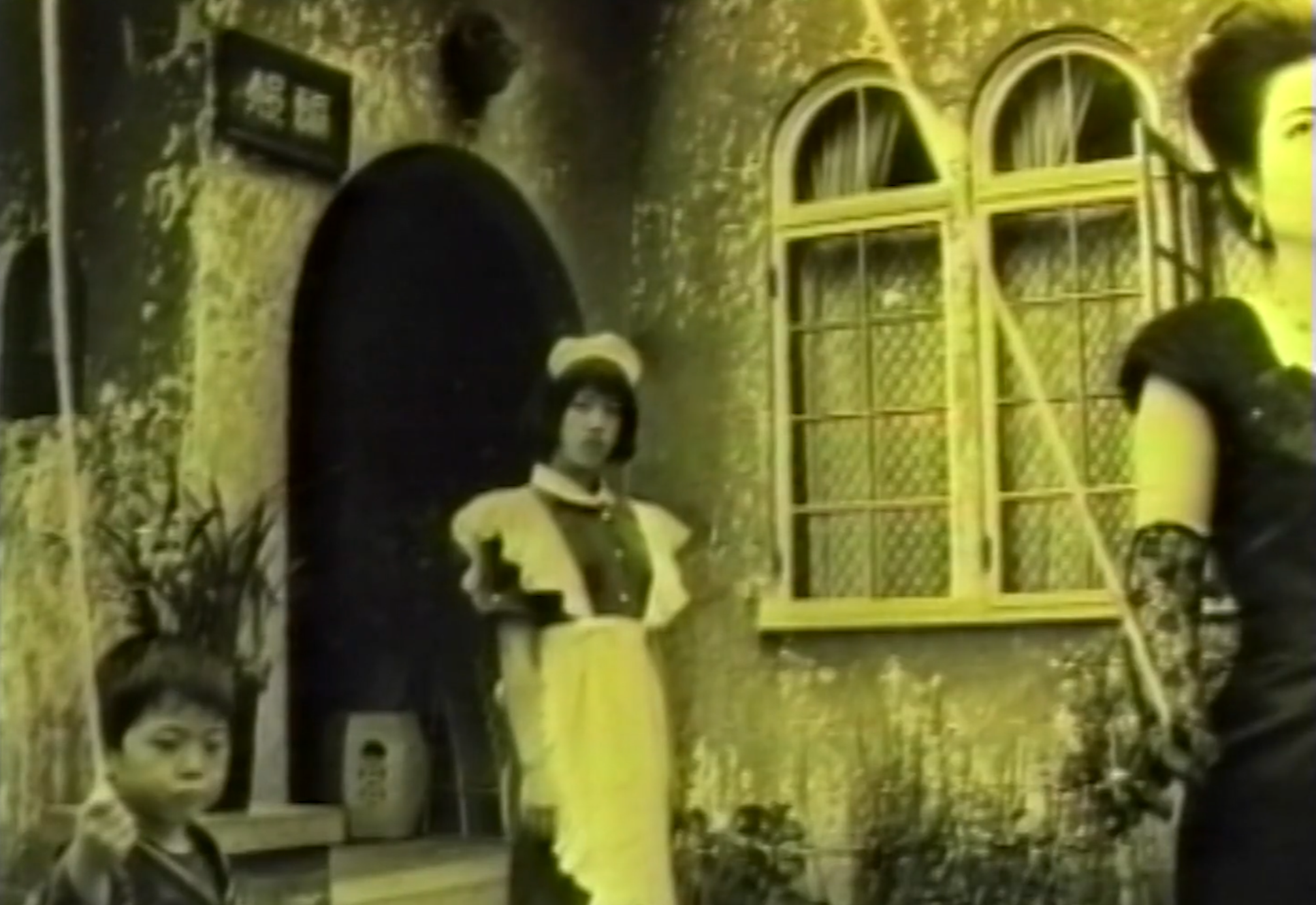
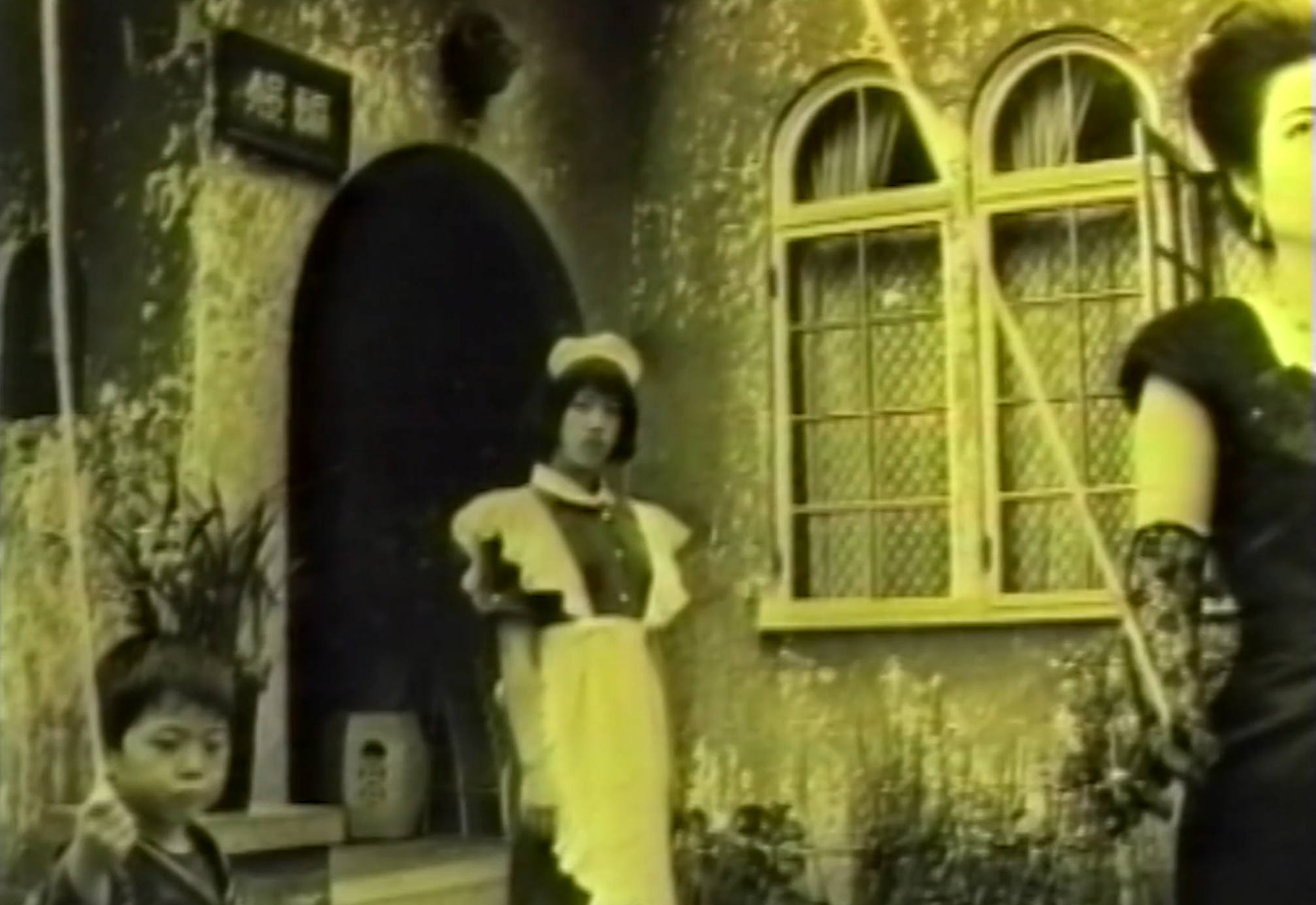
This March, we are delighted to be screening a newly translated work by Mari Terashima — Fortress of Dreams (Yume no toride, 1991). The work, which was scored by the musician Rei Harakami, combines video with montages of still images, telling the story of a maid and her courtship with the young master of the wealthy family for whom she works. The story is told from the maid’s perspective, whose desire, fantasy and longing are refracted through the shadowy architecture of a manor house, in the paintings of Gustave Moreau, and in visions of her lover as a scantily clad angel. Her fragile “fortress of dreams,” however, eventually crumbles into violence.
As Terashima notes, the maid is a much-idealised image in Japanese culture today — a symbol of “moe“ that saturates maid cafés and popular media. Yet in Fortress of Dreams, the maid moves from the object to the subject of fantasy. Her retreat into imagination occurs as a response to her exclusion and isolation from the rigid hierarchy of the fictional manor, reflected in the motif of the maypole around which the family dances in the garden, an image drawn from traditional British springtime festivals. The maid is sidelined from this dynastic ritual much as she can never become a fully-fledged member of the household. There is a sense of the political in the depiction of the maid as a kind of impossible figure, who is oppressed along the lines of both gender and class, and whose desires must be contorted accordingly.
Terashima aligns the protagonist of Fortress of Dreams with the image of the chick that is crushed by the shoe of the young master — “a nameless person who could easily be trampled… a woman who simply couldn’t survive without indulging in fantasies.” At the same time, fantasy becomes for her a kind of weapon, and in this respect, both passivity and control; narcissism and sacrifice; agency and subjugation appear chaotically coagulated in this fascinating character.
Mari Terashima is one of two new artists who have been added to CCJ’s online Viewing Library, along with Yuko Asano. For interested researchers, a selection of Asano and Terashima’s works, along with dozens of others, are available to watch on our online Viewing Library. Month-long access to our entire library is $100 — ideal for those who wish to take deeper look at a cross-section of Japanese experimental film from the 1960s-1990s.
THE PROGRAM WILL BE AVAILABLE FOR VIEWING ON CCJ’S VIEWING PLATFORM.
Become a member for just $5 a month to access our monthly programs, and share your thoughts on our screenings with us via Twitter, Instagram or Letterboxd.
Program

Mari Terashima, Fortress of Dreams・夢のとりで, 1991, 19 min, Hi8 video, color & b/w. Music by Rei Harakami.
Mari Terashima 寺嶋真里
Mari Terashima is a filmmaker. She was born in 1965. She enrolled in a film making course at Kyoto College of Art (Kyoto University of the Art) in 1985, and studied with filmmakers such as Matumoto Toshio. Her 8mm film, Green Bug/Midorimushi won a grand prize at the Image Forum Festival. Two of her works, The Polyester Dog of Her Majesty the Queen/Joou heika no poriesuteru ken and Shot. Cut. Lovers. were selected for Maniacs of Disappearance, an exhibition that was commissioned by the Japan Foundation, and it was exhibited across twelve countries. She joined Split Film Festival in Croatia, and Yamgata International Documentary Film Festival, Japan with Princess Plum P-udding/Himekorogashi in 1999. Alice in the Underworld: The Dark Märchen Show!!, which was commissioned as the 18th original video work produced by the Aichi Arts Center, was officially invited to be exhibited at the 40th Rotterdam International Film Festival. Her personal documentary (self-documentary), Diary of a Rambling Woman / Chūbura onna moyamoya nikki: danna ni ienai himitsu gained an audience award at the Image Forum Festival 2016. (Wakae Nakane)